Peru’s pope targets machismo and abuse
Pope Leo XIV addressed 40,000 people in Lima to demand better treatment of women and to instruct bishops on handling clergy misconduct.
By Takeshi Faure ·
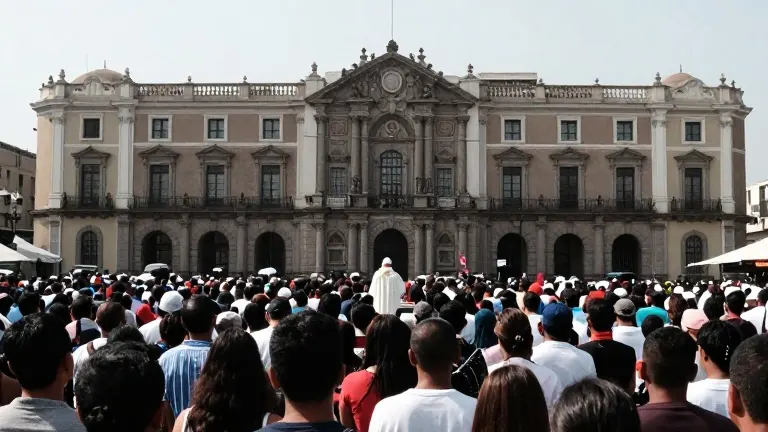
Pope Leo XIV arrived in Lima on Thursday with a clear directive for the Peruvian church: confront the culture of machismo and hold leaders accountable for protecting women and victims of abuse. The 71-year-old pontiff, who served as a bishop in northern Peru for two decades before his 2025 election, addressed a crowd of 40,000 people in the Plaza Mayor. He urged the Catholic hierarchy to model unity and to treat the issue of gender-based violence as a matter of Christian duty.
The visit follows an emotional homecoming on Wednesday, when Leo joined 60,000 people inside a stadium and 300,000 outside for a night vigil. Vatican estimates placed the total audience at 360,000. During the event, the pope sang along to Contigo Perú and the hymn Alma Misionera. Witnesses noted his energy. Ángel Esquives, a craftsman from Chiclayo, arrived at 3 a.m. to secure a spot near the center of the square. Zozimo Perez, wearing a costume he designed, called the visit a gift from heaven.
Leo addressed the physical challenges of his role during a morning meeting with bishops. He climbed a steep staircase without assistance, citing doubters who predicted he would be too weak to travel. He noted that he had undergone lung cancer surgery last month. He told the assembly that God’s grace was greater than their doubts.
The pope’s speech focused on the specific disparities facing women in Peru. He stated that violence against grandmothers, mothers, sisters, and daughters wounds all of humanity. He specifically identified poor, Indigenous, and Afro-Peruvian women as groups that face double penalties. He called for these women to be valued, protected, and respected. Nicole Cruz, an attendee, said the pope’s words could help men understand that women seek support rather than complaint.
National statistics provide context for the pope’s concerns. The National Institute of Statistics and Informatics recorded 1,261 femicide victims in Peru between 2016 and 2024. The number of women killed because of their gender rose by 44% during that period. Cruz acknowledged that while women have gained suffrage and voice, femicides remain a rising concern.
Leo instructed Peruvian bishops to respond to clergy sexual abuse with truth and justice. He described the scandal as a reality that has caused pain. He told the bishops to enter homes, accompany the sick, and reach out to remote communities. He urged them to model their vocation after St. Turibius de Mogrovejo, the 16th-century archbishop of Lima who learned Indigenous languages to communicate the faith.
The pope met with six survivors of abuse for one hour on Thursday. The group included former members of the Sodalitium Christianae Vitae. Pope Francis suppressed the group last year after investigators found sadistic abuses of power and financial misconduct. The Sodalitium still holds economic power in Peru. José Escardó, the first whistleblower, criticized the church’s response. He said Leo has not replied to his letters for over a year. Escardó argued that abuse constitutes a crime that must be punished, not a mistake to be forgiven.
The online database BishopAccountability has identified 77 clergy members in Peru accused of sexually abusing minors. The organization stated that this number is a small fraction of the total, noting that many victims have not yet come forward in a country where the church holds strong influence.