California Coast: Erosion and El Niño Meet Million-Dollar Real Estate
A super El Niño event is expected to bring heavy surf to Southern California, testing the value of beachfront homes while insurance costs rise and sand prices soar.
By Takeshi Faure ·
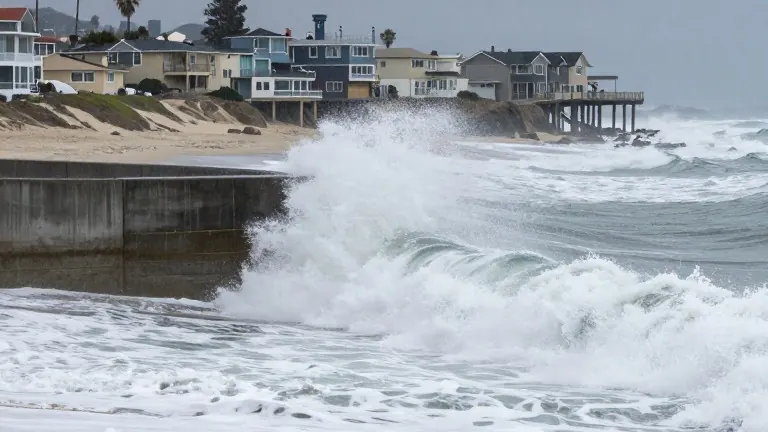
Essam Heggy, a research scientist at the University of Southern California, co-authored a report in 2024 warning that development is rapidly degrading the state's coastline. The study predicts that the cost of maintaining beaches through sand dredging and dune formation will increase fivefold by 2050. This financial burden arrives as a super El Niño is expected to bring intense waves and heavy rain to the region this winter.
A separate report from the Public Policy Institute of California found that rising sea levels could erode one to two-thirds of Southern California beaches without major intervention. The report estimated that billions of dollars in building value could be destroyed. These hazards are already visible in communities like Huntington Beach and Long Beach, where recent flooding has damaged infrastructure and homes.
Insurance premiums are rising in response to these risks. Aaron Farmer, president of California Flood Insurance, reported a surge in calls from residents seeking coverage. He stated that the company stopped using Google advertising because demand is already high. Farmer estimated that 80 to 85% of people living near the coast are under-insured. Many homeowners are now seeking policies for $1 million or $2 million, far exceeding the typical $250,000 maximum policy limit.
Despite the rising costs, oceanfront real estate values remain high. In Malibu, a vacant coastal lot sold for $1.7 million in 2011 is now asking $34.5 million. A mansion that sold for $2.4 million in 2005 is listed for $88 million. Real estate agent Daniel Milstein noted that while some buyers are considering moving slightly inland, there is no exodus from the coast. He described the shift as a change in perception regarding the risk of living by the water.
Jess Lopez, 31, rents a first-floor apartment in Huntington Beach. Her street experienced minor flooding in October. She is deciding whether to renew her lease in the spring. Lopez said her renter's insurance does not cover external flooding. She expressed concern about losing her belongings, noting that owning a home would increase her stress.
Mitchell Leib, 67, lives in a beachfront home in Malibu. A storm in September sent boulders crashing into his property. He considered moving but decided to stay. Leib, who retired as president of music for Disney's live-action film division, said he is prepared for the natural risks of coastal living. He compared the situation to living in a forest and expecting encounters with bears.
Heggy argued that public resources should not be used to protect private homes in fragile areas. He suggested that some coastal areas should become public parks instead of residential estates. He noted that the landscaping on these estates, which often includes lawns and large trees not native to the desert climate, traps sediment and prevents it from replenishing the beach.
The Long Beach peninsula offers a current example of the market adjusting to damage. An oceanfront house listed for $4.95 million was severely damaged by record swells in September. The property is now listed for $2.9 million. The price cut reflects the physical damage but remains a high price for a home likely to face future flooding.
Mike Davis, who wrote a 1998 essay arguing against rebuilding in disaster-prone areas, suggested that spending millions to save properties that will eventually be destroyed is a waste of public funds. Heggy agreed that the cycle of building, flooding, and rebuilding is inefficient. He pointed to Alexandria, Egypt, where roughly 40 buildings collapse every year due to erosion and rising sea levels.
More Business · Customer Complaints · Report a business · Got a Story?