Bighorn-Horsethief cave system reaches 17 miles of mapped passage
Volunteers from the National Speleological Society are updating surveys of the complex, which spans 16,000 feet in depth and offers rare scientific data on the region's geological history.
By Takeshi Faure ·
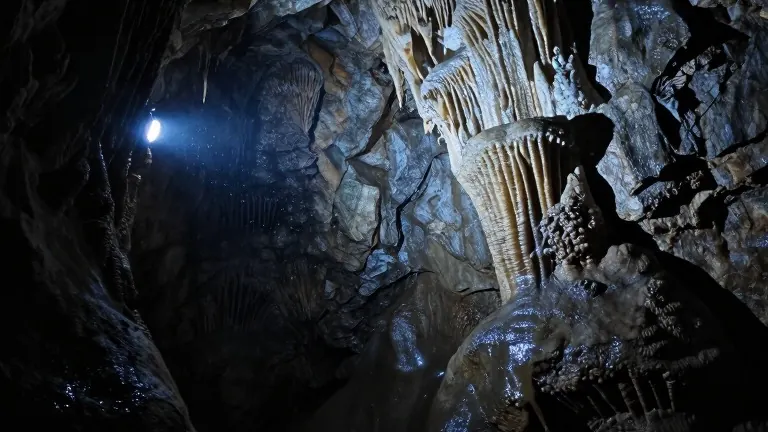
Volunteers from the National Speleological Society have added 17 miles of surveyed passage to the Bighorn-Horsethief cave system in Wyoming, according to Ryan McKenzie, a specialist in cave management for the National Park Service. The group has spent the past five years working near the Bighorn Canyon National Recreation Area to update maps of one of the longest cave systems located west of the Black Hills.
McKenzie noted that the cave provides critical habitat for bat populations and offers a rare glimpse into an underground environment. He stated that the site provides important data on the geological formations that tell the story of millions of years of development. The cave entrances are situated approximately 15 miles east of Lovell, Wyoming, on land managed by the Crow Indian Reservation.
The area is also located near the old Prairie Mining Camp, a site used by cavers as a temporary headquarters. While the known system is now 17 miles long, McKenzie suggested that hidden sections within the caverns could extend the total length to at least 30 miles. He observed that the system is increasingly complex, with every mapping effort adding to the understanding of how the cave developed and how different passages connect.
The limestone formations date back approximately 260 million years, according to the National Park Service. Portions of the Horsethief Cave have been dated to more than half a million years ago. The age of the cave is contained in a portion located a half mile from the entrance, named the Powder Mountain Room. The name originated from a pile of ash that filtered into the cave through an opening created by the Yellowstone eruption that formed the Yellowstone caldera.
The cave was not fully revealed until the 1970s, when an Italian caver was looped to a break in the ceiling. A woman later pulled out some rock, and a passage was forever attached to the cave passage as the Venus's Crystal Crawls. McKenzie said that once past that point, there are numerous walled passages branching off as cavers move forward. He added that if a caver says 30 feet, they may find three to five directions to go, describing it as a lot of Swiss cheese.
The numerous passages may not be easily accessible due to the effort required for cave mapping. McKenzie stated that the work helps land managers, scientists, and cavers better understand and protect these resources for future generations. He also noted that the work emphasizes how easily a cave's environment can be damaged. The cave is considered the state's prettiest due to its numerous formations, including mineral deposits formed by seeping water.
The cave also contains radon gas, a naturally forming radioactive gas that is a health risk. The gas holds the average age of the site for about a decade. In 2012, a Billings Gazette article described the cave as the most popular of a trio in the area. That same year, about 200 people entered Horsethief Cave, and a Park Service plan called for more than 500 visitors on average. McKenzie said that about 150 people visit now, depending on the year.
Controlling access also limits exploration for the public. McKenzie said he wants to be very cautious because caving is a dangerous activity. The entire Forberg family is involved in the exploration, including the couple's two children, ages 8 and 10. McKenzie described the activity as physically exhausting on the legs and back, but extremely challenging and wonderful.