I Voted Stickers Return
The simple paper emblem has remained a constant symbol of civic participation for decades, regardless of how voting technology changes.
By Lucas Sheridan ·
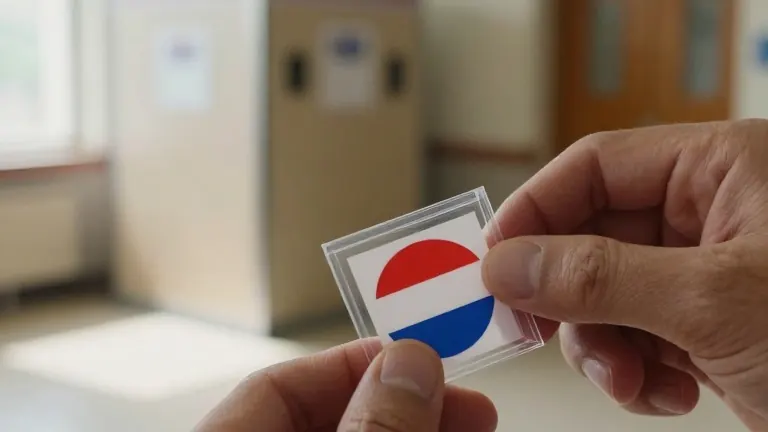
Voters leaving polling places across the United States continue to receive a small piece of paper to affix to their clothing. This practice, which began in the mid-twentieth century, serves as an immediate visual confirmation that a citizen has cast a ballot. The sticker typically features the words "I voted" in bold lettering, with no indication of political party or candidate preference.
Ted Anthony, a writer for the Orange County Register, traced the origins of this tradition to his own experience in 1976. He recalled standing behind his mother in Hampton Township, Pennsylvania, as she used a lever voting machine. After she completed her ballot, the machine operator handed her a sticker. Anthony, then eight years old, received the item from his mother. He noted that the act created a shared moment of civic participation that transcended the political divisions of the era.
The physical form of voting has shifted over the last fifty years. Many jurisdictions have replaced lever machines with touch screens or paper ballots filled in with markers. Despite these technological changes, the distribution of the sticker has remained consistent. Anthony observed that while the methods for marking a choice have evolved, the ritual of emerging from the polls with the emblem has not changed.
The design of the sticker has remained largely static. Unlike political campaign buttons, which often feature candidate names, slogans, and party symbols, the voting sticker uses a standard text. Anthony pointed out that the lack of specific advocacy makes the item difficult to challenge or interpret. It functions as a neutral marker of democratic duty. The colors are usually red, white, and blue, but the message is universal.
Some citizens have developed personal traditions around the items. Anthony described a friend who collected the stickers over many years. She would wear multiple stickers on her lapels and chest, reapplying the adhesive as needed. Her collection served as a record of her ongoing participation in the electoral process. This practice mirrors the habit of collecting political buttons, a tradition that dates back to the 1888 presidential race.
The article is part of a recurring series titled "American Objects" that marks the 250th anniversary of the United States. The series examines items that represent aspects of national identity and daily life. The voting sticker is presented as one of the few unifying symbols in a polarized political environment. It signals to observers that the holder has engaged in the fundamental act of the American democratic republic.