The 36 Governor Races: A Split Field With 19 Open Seats
With Republicans and Democrats each holding 18 of the contested governorships, voters in nine battleground states will decide if the party majority changes hands.
By Sanjay Caldwell ·
Governors' races in thirty-six states are set to define the balance of power in statehouses across the country on Election Day. Republicans hold twenty-six governor's offices nationally while Democrats hold twenty-four. Among the specific contests on the ballot this Tuesday, the split is exactly even, with each party currently holding eighteen of the thirty-six seats. This parity creates a high-stakes environment where a net gain of two governorships is required for Democrats to secure a nationwide majority, a status Republicans have maintained since 2010.
The complexity of this year's gubernatorial elections is heightened by the absence of incumbents in nineteen of the thirty-six races. Ballotpedia notes that fifteen governors are term-limited and cannot seek re-election. Additionally, three sitting governors chose not to run again: Kim Reynolds of Iowa, Tim Walz of Minnesota, and Tony Evers of Wisconsin. Rhode Island's Daniel McKee also vacated his seat after losing his primary. These open seats provide opportunities for challengers to break the historical pattern of incumbency advantage, forcing candidates to build recognition and policy credibility from the ground up.
Nine states are considered battlegrounds for governor, a list that includes Alaska, Arizona, Georgia, Iowa, Kansas, Michigan, Nevada, Ohio, and Wisconsin. In these states, the outcome of the governor's race could shift the national partisan map. Democrats are defending five governorships in states that Donald Trump won in 2024, specifically Arizona, Kansas, Michigan, Pennsylvania, and Wisconsin. Conversely, Republicans are defending two governorships in states that Kamala Harris won, namely New Hampshire and Vermont. These defensive efforts are critical for both parties as they seek to stabilize their respective state-level coalitions.
Specific matchups have drawn national attention due to the prominence of the candidates. In Georgia, Republican health care executive Rick Jackson faces Democratic former Atlanta Mayor Keisha Lance Bottoms in a race to succeed Brian Kemp. In Nevada, Republican Governor Joe Lombardo is challenging Democratic Attorney General Aaron Ford. The Associated Press describes these contests as pivotal tests of each party's appeal to suburban and rural voters alike. The outcome in these states will signal whether the national mood reflected in presidential polls translates to down-ballot contests.
Other competitive races include Ohio, where Republican Vivek Ramaswamy is running against Democrat Amy Acton. Ramaswamy's campaign recently faced backlash over an advertisement featuring Acton's estranged mother, a move that has intensified the partisan dynamics in the state. The AP also identifies Texas, Florida, and Iowa as competitive governor races, suggesting that the fight for statehouses is not limited to the traditional nine battlegrounds. These additional competitive areas indicate a broader swing in voter sentiment that could impact the overall count of governorships held by each party.
The financial dynamics of these races reflect the broader trends in the 2026 midterm elections. Republican committees have outraised and outspent Democratic committees at the committee level, aided by Trump-affiliated groups and support from Elon Musk. However, at the candidate level, Democrats have outraised their opponents. This divergence suggests that while Republican infrastructure is well-funded, Democratic candidates are effectively mobilizing grassroots resources to compete in key governor's races. The efficient deployment of these funds will be crucial in states where margins of victory are expected to be narrow.
Redistricting has also played a role in shaping the political landscape for these gubernatorial contests. Six states, including California, Florida, Missouri, North Carolina, Tennessee, and Texas, are using new congressional maps following mid-decade redistricting. Ohio is also utilizing a new map. While these maps primarily affect congressional districts, they can influence the overall electoral environment and voter registration trends in the states. The AP notes that Republicans tried to beat the typical midterm pattern of losing seats with these redistricting efforts, but the new districts may not vote as initially projected.
The mood among voters in these governor races mirrors the national referendum on the administration's performance. The AP describes the election as a response to high prices and an unpopular war with Iran. In the context of governor's races, these economic and foreign policy concerns are being filtered through the lens of state-level leadership. Voters are looking for candidates who can address cost-of-living issues and provide oversight of federal actions. The ability of candidates to articulate clear positions on these topics will be a deciding factor in the nine battleground states.
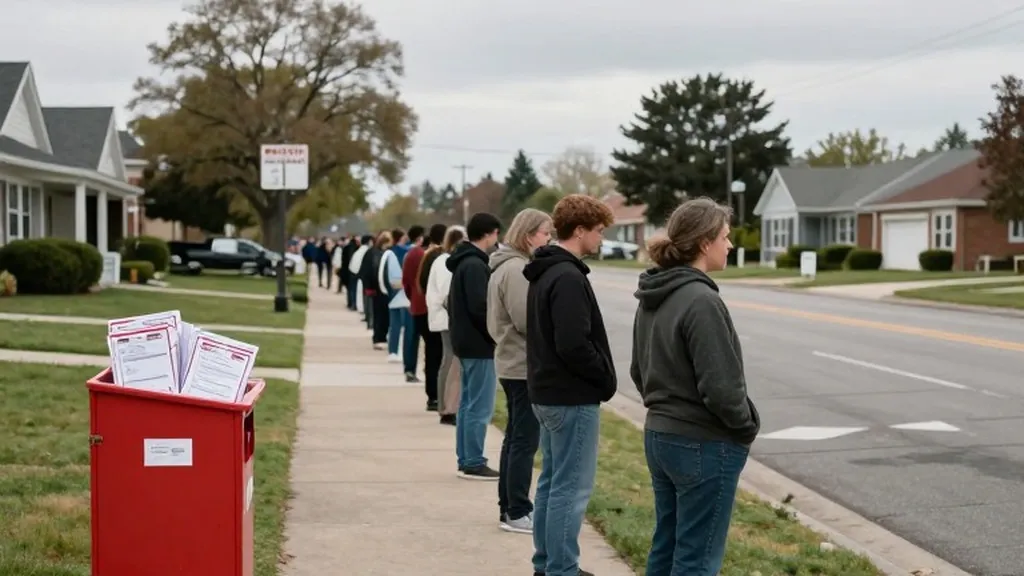
Early voting trends indicate a high level of engagement in these contests. More than 57 million people had already voted as of Monday, surpassing the early vote of four years ago in many closely watched states. This early surge suggests that voters are making their decisions on governor's races with the same urgency as they are applying to congressional elections. The high turnout is expected to continue throughout the day, with polls open in all thirty-six states. The final count will reveal whether the 18 to 18 split remains intact or if one party secures the additional two seats needed for a national majority.
Democrats are described as cautiously optimistic about their chances in these races. The party's strategy focuses on holding its current positions while making inroads in states with open seats. A strong performance in the governor's races would boost potential 2028 candidates and signal a broader shift in political power. Conversely, Republicans are bracing for a tough night, aiming to hold their current eighteen seats and potentially expand their majority. The outcome of these thirty-six races will be a key indicator of the overall success of the administration's party in the midterm elections.